Reading time: 5 min
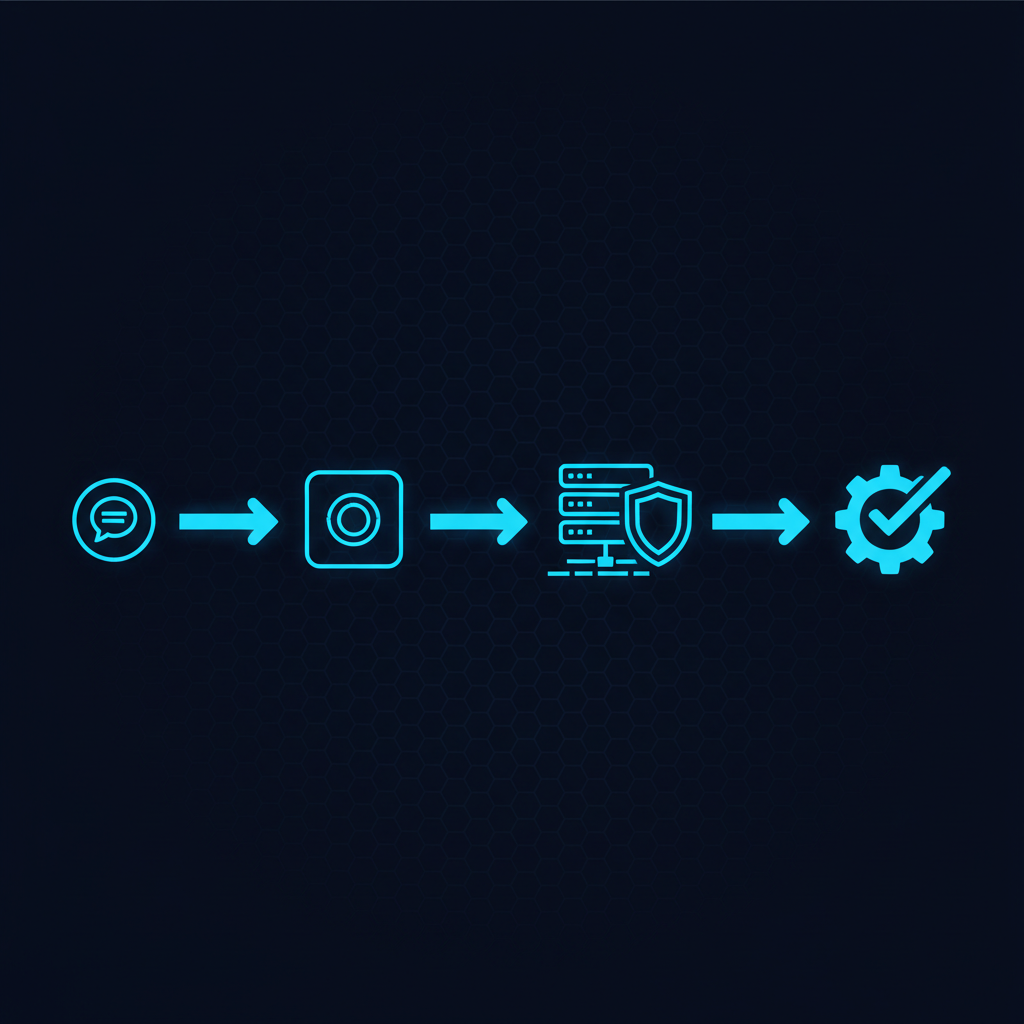
From the first call to a working Digital Worker runs a short, predictable path. We start with a 30-minute call, no deck, where we tell you plainly whether a Digital Worker is the right tool for you or not. Then we pick one concrete task, run it single-tenant on your infrastructure, tune it on your real documents, and show a first working test, usually within a few weeks. Only then do you decide whether to widen the scope. Below we break that path into steps, so it is clear what it asks of your side and what it deliberately leaves out.
Step 1: a call, 30 minutes, no deck
The start is simple: a short call where you describe the process you want to offload, and we tell you plainly whether a Digital Worker is the right tool or not. No 40-slide deck, no commitment. If your case is better solved by an ordinary copilot or by tidying your documents first, we say so on that call, not after a contract is signed. We begin not with the model but with one task that has a clear owner and a clear source, because that is what decides whether a deployment makes sense at all.
Step 2: one task, not „AI for everything"
Instead of promising a general company AI, we pick one repeatable document process: triaging RFQs, reading a drawing to draft a quote, or handling service documentation. We choose the task by three traits: it repeats often, it eats expert time today, and it has a reasonably tidy source. That kind of case shows value fastest and is easiest to hold to account. A narrow scope with a single owner on your side produces a result you can judge before you widen the use. That is a deliberate limit, not a lack of ambition. Where the role of a Digital Worker ends and a person's decision begins we covered in the post on its honest limits.
Step 3: deployment on your infrastructure
The chosen task runs single-tenant, on your infrastructure, in an isolated environment. Data does not leave your perimeter and does not travel to a public API. This is the same posture we describe around NIS2 and audit: when an auditor asks where data is processed, the answer „a dedicated environment, only ours" defends itself in one sentence. Which deployment model fits your data we unpacked in the piece on single-tenant versus shared cloud.
Step 4: working on your documents
A Digital Worker is only as good as the documents it works on. We do not train or fine-tune the model on your data: your documents are used only as a source at the moment of answering. So we work on your real formats: drawings, BOMs, tickets, not examples pulled from the internet. We do not ask for access to everything at once, only the documents needed for this one task. On your side we need one person who knows the process and can tell us when an output is good and when it is not. That is a few hours of attention per cycle, not a full-time role. You report what breaks and see the fix in the next release, with no first-line support layer between you and the product team.
Step 5: a first working test, then the decision
The goal of the first stage is not a demo on a slide, but a working test on your data, usually within a few weeks. It shows plainly where a Digital Worker genuinely takes work off your team and where a person's role begins. Only on that basis do you decide whether to widen the scope. We run early partners in a co-development model with a KPI guarantee: together we agree what should improve, and we measure it on your data. The details of the program we described in the post on co-development with a KPI guarantee.
How long it takes, and what it depends on
„A few weeks" is not a promise from a price list, it is the typical rhythm of a first working test. The real timeline depends on three things: how clean the sources are, how clearly the process is defined, and how quickly the person on your side judges each result. The longest part is usually not the technology but tidying the documentation, because a Digital Worker surfaces mess in the sources rather than hiding it. That is why, on the first call, we ask not only about the task but about the state of the documents meant to feed it.
What this path leaves out
There is no 40-slide deck before a conversation about your real process. There is no promise of „AI for everything," because a narrow task is easier to hold to account than a broad claim. There is no signing on faith before you see the result on your own data, because the first test exists precisely so you can decide on facts. Nor is there a hidden dependence on us: we work on your infrastructure and your data, so you keep control of the environment. If at any step a Digital Worker is not the right tool, we say so plainly. The limits are part of the offer, not its hidden cost.
The next step
The simplest way to start is one task with a clear source and a clear owner on your side. On a short call we will judge together which task in your company is the right first, honest test. Book a call with Fryderyk, 30 minutes, no pitch.
Author: Fryderyk Pryjma, CortexMine. We work with manufacturers on private Digital Worker deployments on their own infrastructure.
Prefer to check on your own first? The readiness mini-audit takes 10 minutes and leaves no data behind.