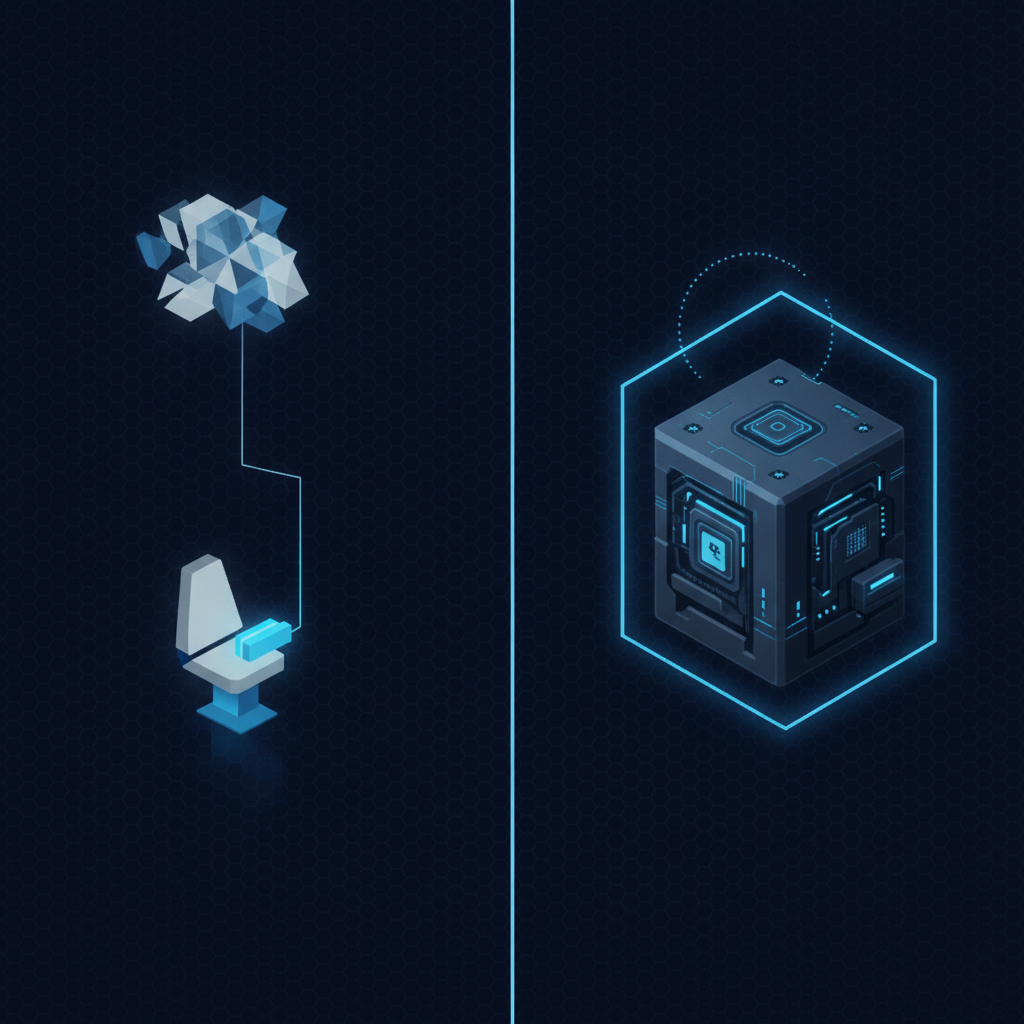
"Do you have a copilot or something else?" is the first question manufacturers ask when they start thinking about AI in day-to-day operations. The catch is that a copilot and a Digital Worker aren't two versions of the same product. They're two different models of what AI inside a company is meant to be: an add-on to someone else's SaaS, or a component running on your own infrastructure.
This piece separates the two, without arguing that one model always wins. For some companies a copilot is enough. For a regulated manufacturer with data that cannot leave the building, the equation looks different.
Copilot: a seat in someone else's cloud
A SaaS copilot is a per-user license, you buy a "seat," and the work happens on the vendor's infrastructure. You log in, write a prompt, get an answer. The model is shared with the rest of the world, and your data travels back and forth across a public API.
This has real advantages: it starts in minutes, needs no hardware or MLOps team of your own, and the cost is predictable and monthly. For office work with no sensitive data, drafting emails, summaries, brainstorming, it's often the right call.
The line appears wherever sensitive context does. For a copilot to help with your specific drawing, BOM or service ticket, it has to see that data. And "see" means sending it to the vendor's servers.
Digital Worker: a component on your own infrastructure
A Digital Worker is a different unit of billing and a different architecture. You don't buy seats for people, you run a function that performs a defined scope of work on your data, on your infrastructure. Workers, not seats.
The difference isn't cosmetic. A Digital Worker:
- runs where your data lives, in a single-tenant private cloud or on-prem, with no traffic to a public API;
- is embedded in one workflow, reading a drawing and drafting an offer, service assistance, generating instructions, rather than a general-purpose "chat for everything";
- leaves an auditable trail, you can see which sources an answer was grounded in, which matters under a NIS2 audit;
- scales by scope of work, not by headcount logging in, one Worker serves a process used by a whole department.
This isn't "a copilot, but private." It's a different model of what AI does in a company and where it does it.
Four axes where they genuinely differ
- Where your data sits. SaaS: on the vendor's servers, shared model. Digital Worker: on your infrastructure, isolated. That's the first and most important difference for regulated manufacturing.
- What the unit of value is. A copilot prices access per person. A Digital Worker prices work done in a process. With a team where many people touch the same process, the two cost models diverge.
- How wide the scope is. A copilot is a general tool that "does a bit of everything." A Digital Worker is narrow and deep, it does one thing well and is embedded in your context.
- Whether a trail remains. SaaS rarely gives full control over what the model saw and what it grounded an answer in. A Digital Worker is designed so that trail exists, because without it, the audit is hard.
When a copilot is enough, and when you need a Digital Worker
The honest answer depends on the data you work with and how you're regulated.
A copilot is enough when: the work involves general content with no sensitive data; you want a fast start without your own infrastructure; you're not under hard data-isolation requirements. That's not the "lesser" choice, it's simply a different use case.
A Digital Worker fits when: AI has to touch drawings, formulations, process documentation or customer data; you're an entity under NIS2 and an audit will ask where data is processed; you want to embed AI in a specific, repeatable process rather than hand people another chat; you need an auditable trail.
In practice the two worlds don't exclude each other. A company can use a public copilot for office work and run a Digital Worker wherever data that cannot leave the building is in play. There's only one real mistake: using a public copilot where the isolation requirement is real, because then today's convenience becomes tomorrow's audit problem.
How to approach the choice
Start with one question: does the process you want AI to help with touch data that cannot go to the public cloud? If not, a copilot is probably enough and there's no point building more. If yes, the question is no longer "copilot or Digital Worker," but "which deployment model to run private AI in." And that's a different, far more concrete conversation.
Not sure whether your process needs private AI or a copilot will do? Book a 30-minute call with the founder, no pitch, just your case.
Prefer to check on your own first? The readiness mini-audit takes 10 minutes and leaves no data behind, and the value calculator gives you the order of magnitude.