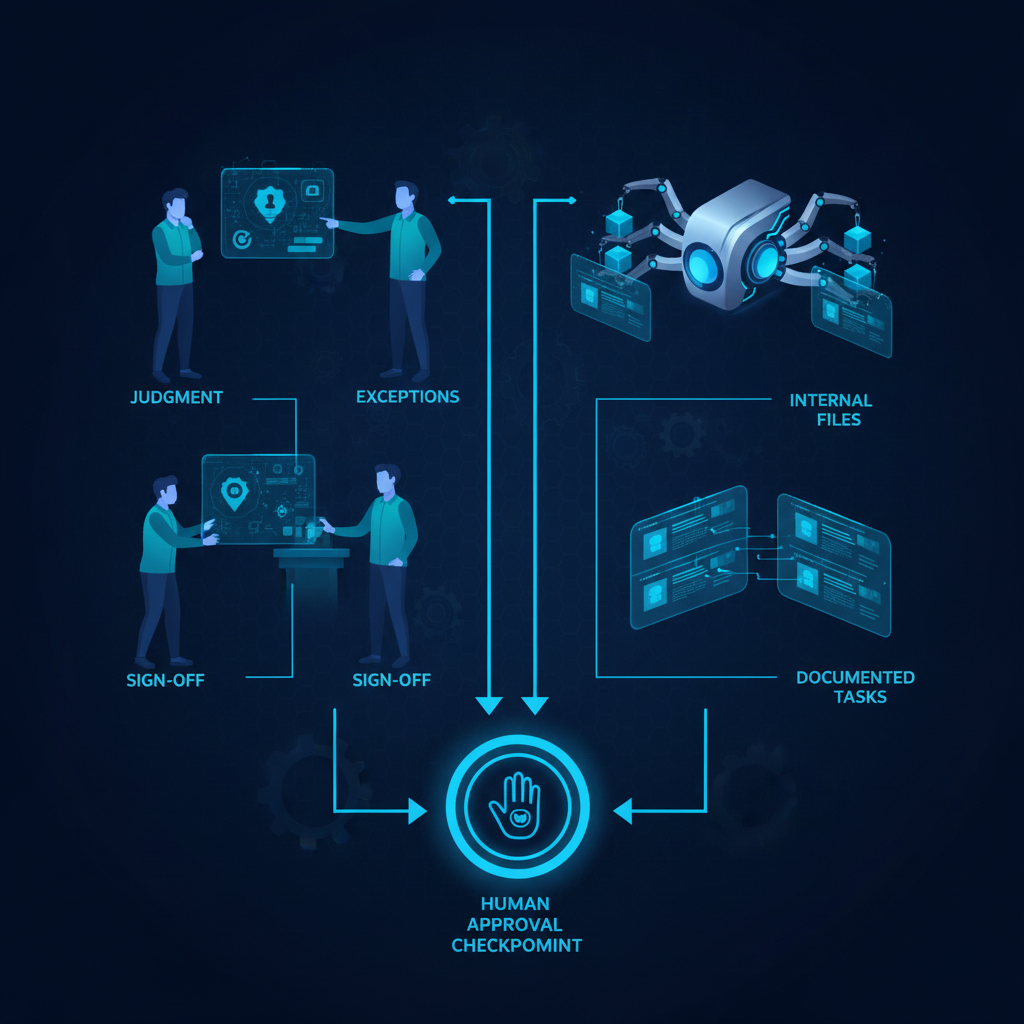
A Digital Worker does not add a line to payroll or a box to the org chart. It changes something else: how the team splits its work. It takes on a narrow, repeatable, well documented slice of tasks, while people move toward judgment, exceptions, relationships, and ownership of the outcome. This is not „AI instead of the team": a person still stands behind every result and signs off on it. This is the second post in the series on Digital Workers. The first explained the pricing model, this one covers the real organizational shift: who does what, who reviews, and who is accountable.
A Digital Worker is a unit of work, not a new headcount
In the first post in the series we explained why we charge for work done rather than for seats. The same logic governs how a Digital Worker joins a team. It is not one more tool everyone logs into, it is a unit that carries out a defined piece of work. We broke down the difference between a tool and a unit of work in the piece on a Digital Worker versus a copilot. The consequence for the team is simple: you are not adding a new feature to everyone's interface, you are handing over a specific task.
What moves to the Digital Worker, and what stays with people
The line does not run along „easy versus hard", it runs along „documented and repeatable versus needing judgment". Work with a source and a rule goes to the Digital Worker: searching documentation, pulling data from many files, drafting a first version of an answer or an offer from what already exists inside the company. What stays with people is what cannot be reduced to a rule: reading an ambiguous case, deciding on an exception, talking to a customer, taking responsibility for the final document.
A service example: a ticket comes in, the Digital Worker drafts a proposed resolution from manuals and past tickets, and a technician verifies it and closes the case. We showed how that looks in practice in the piece on an assistant working on service documentation. Quoting works the same way: the path from a drawing to a draft offer is work for the unit, while pricing and the sales conversation stay with the person.
In practice the simplest test is this: if a task can be described with the sentence „take this source and do that with it", it fits a Digital Worker. If it needs the sentence „it depends", it stays with a person. That is why choosing the first task is a conversation about your processes rather than about the technology itself, and why the same function at two manufacturers can land on a different side of the split. The line is not fixed forever either: some tasks that need judgment today can later move to the unit once the rules are written down and the sources are put in order, but that is a decision the team makes, not the machine.
A new role appears: someone has to run the Digital Worker
This is the part that is easy to miss. A Digital Worker does not free the team from thinking, it moves part of the effort onto a different track. Someone has to define what „done" means, maintain the sources the worker relies on, and review edge cases. In practice an owner role emerges: a person who knows the unit's scope, guards the quality of its sources, and knows when to widen a task and when to narrow it. This is a real organizational cost. It does not disappear, it changes shape.
„Human in the loop" is not a formality, it is a split of accountability
In a manufacturing setting, and especially under NIS2, what matters is not only the result but who answers for it. The Digital Worker prepares a draft grounded in sources, a person approves it. Accountability stays with the human, while the record of which data produced the answer stays with the system. That distinction is the core of it: the point is not for the machine to „be right", but for it to be possible to check where the answer came from, and for someone to accept it deliberately.
What this change does not mean
We do not promise that a Digital Worker shortens the payroll. For a skeptical industrial IT team that matters: the change is about the split of tasks, not the number of jobs, and every organization will play it differently. It also does not mean full autonomy, because work without oversight is not the mode in which a Digital Worker makes sense. And it is not an overnight change: it sensibly starts with a single task, not with a team reorganization. Where exactly the limits of what a Digital Worker will not do sit, we will cover in the next post in the series.
Where to start in the team
The safest start is a single narrow task with a clear source (documentation, history, files) and a clear owner on the human side. You test the fit on that one case, and only later widen the scope. If you want to work through this on your own specific process, book a call with Fryderyk. We will go through which task in your team is the right first step.
Author: Fryderyk Pryjma, CortexMine. We work with manufacturers on private Digital Worker deployments on their own infrastructure.
Prefer to check on your own first? The readiness mini-audit takes 10 minutes and leaves no data behind.