Reading time: about 6 minutes
Answer first. A documentation-grounded service assistant is a Digital Worker that searches your service manuals, part sheets, repair history and reports, then answers a technician's question asked in plain language, citing the source. Instead of paging through hundreds of PDF pages, the technician asks „what is the torque for this joint in this variant" and gets the relevant procedure fragment plus a link to the document. The key point: the model runs on your data, on your premises, without sending documentation to a public cloud. Below I show where such an assistant genuinely helps, why it has to be private, and what not to expect from it.
What a documentation-grounded service assistant does
The starting point is mundane. Service knowledge in a plant lives across dozens of files: manufacturer manuals, technical run books, diagrams, part catalogues, notes from past repairs. The technician knows the answer is in there somewhere, but finding it takes time that a stoppage does not allow.
A service assistant flips that process. The documentation goes into a private index, and the Digital Worker answers a question asked in natural language, quoting the specific fragment and pointing to the document it came from. This is not a keyword search returning a list of files. It is an answer grounded in a source that the technician can verify at a glance.
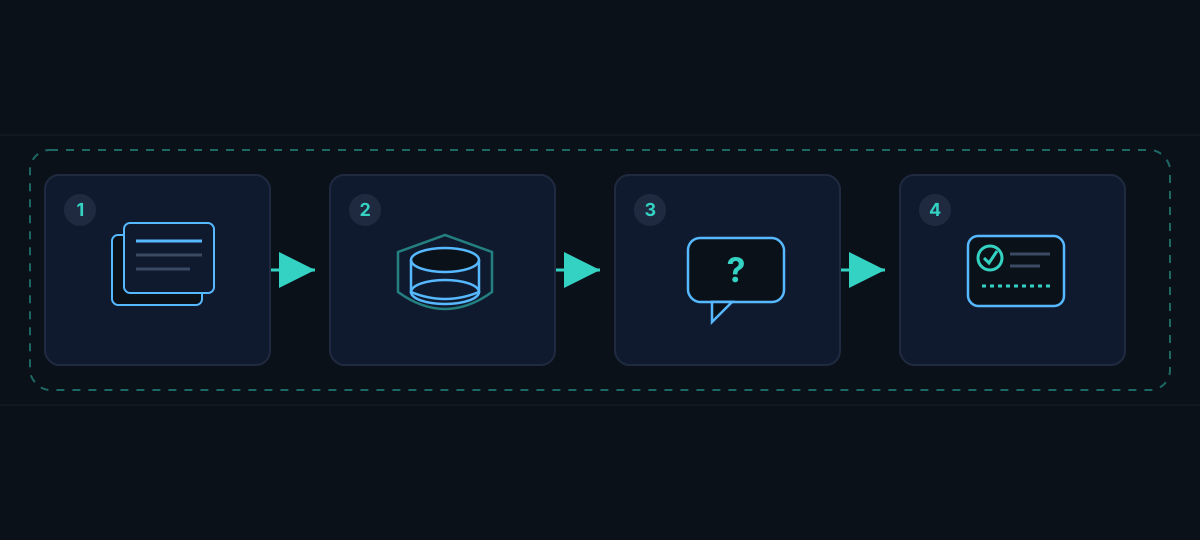 Four steps: documentation goes into a private index, the technician asks in plain words, the assistant returns an answer with a source reference. All within your own infrastructure.
The difference from an ordinary public chatbot is fundamental. A public model answers from general knowledge and can make things up. An assistant grounded in your documentation answers from your sources, and if something is not in the documentation, it says so plainly instead of inventing. I described the same logic when comparing a Digital Worker in quoting from a drawing: same pattern, different department.
Where it genuinely helps
Not in every task and not instead of a person. Below are four situations where a service assistant lifts the search work off the technician, and what it deliberately does not replace.
| Situation | What the assistant does | What it does not replace |
|---|---|---|
| Finding the right procedure | Points to the right manual fragment in seconds and cites the source | The technician's judgement on site |
| Repair history of a machine | Gathers past tickets, part swaps and conclusions in one place | Diagnosis from inspection and measurement |
| Onboarding a new technician | Answers questions straight from the documentation instead of pulling a senior colleague away | Mentoring and informal know-how |
| Drafting a report | Proposes a draft based on gathered data and a template | A person's signature and accountability |
The common denominator: the assistant shortens the path to information but does not take over the decision. The technician stays the owner of judgement, and the assistant hands over material in seconds instead of minutes of paging.
Why it has to run on your data, on your premises
Service documentation is often sensitive property: diagrams, process parameters, machine configurations, knowledge of a line's weak points. Dropping it into a public tool means it leaves your environment and you lose control over where it ends up. This is exactly the mechanism I described with shadow AI in the factory: a policy ban does not go away until there is a safe alternative within reach.
A service assistant running locally, on your infrastructure, solves this at the root. The documentation does not leave the building. Queries and answers can be logged, so a trail forms of who asked what and which document the answer came from. For firms under NIS2 this is not cosmetics, it is the condition for the tool to pass an audit at all. I develop the regulatory thread in the guide to NIS2 and AI.
It is also why the billing model differs from typical SaaS. You pay for work done by the Digital Worker, not for the number of seats purchased. I expand on that in Digital Workers, not seats.
What such an assistant will not do
Stated honestly, because trust in the tool on the floor depends on it.
It will not replace inspection and measurement. The assistant works on what is written down. It cannot see the actual state of the machine. An answer from documentation is a starting point for the technician, not a diagnosis.
It will not invent a procedure that is not there. That is actually a strength: grounding in sources limits fabrication. But it has a flip side. If the documentation is patchy or out of date, the assistant will not supply what is missing from it. Answer quality is a function of documentation quality.
It does not take responsibility. A person signs the report. The assistant can prepare a draft and gather data, but the technician owns the result and answers for the decision.
Frequently asked questions
Does our documentation leave the building or train someone else's model?
No. In the on-premises variant, documentation and queries stay in your environment. Data is not sent to a public cloud. Your documents are never used to train or fine-tune the model, neither on our side nor on yours. The model uses them only as a source at the moment of answering.
Which documentation formats are supported?
Typically PDF, text and office files, spreadsheets, and scans after text recognition. Ticket databases and repair history can be connected as an additional source.
How do we know an answer is reliable?
Every answer points to the fragment and source document, so the technician verifies it at a glance. That is the key difference from a public chatbot, which answers without citing a source.
How much documentation is needed for this to make sense?
From a few hundred pages upward the time saving is already noticeable. You do not need perfect file order, though consistent naming and up-to-date documents raise answer quality.
Want to see how this looks on a fragment of your own service documentation? Book a short call with Fryderyk and we will walk through a real case from your plant.
Prefer to check on your own first? The readiness mini-audit takes 10 minutes and leaves no data behind.