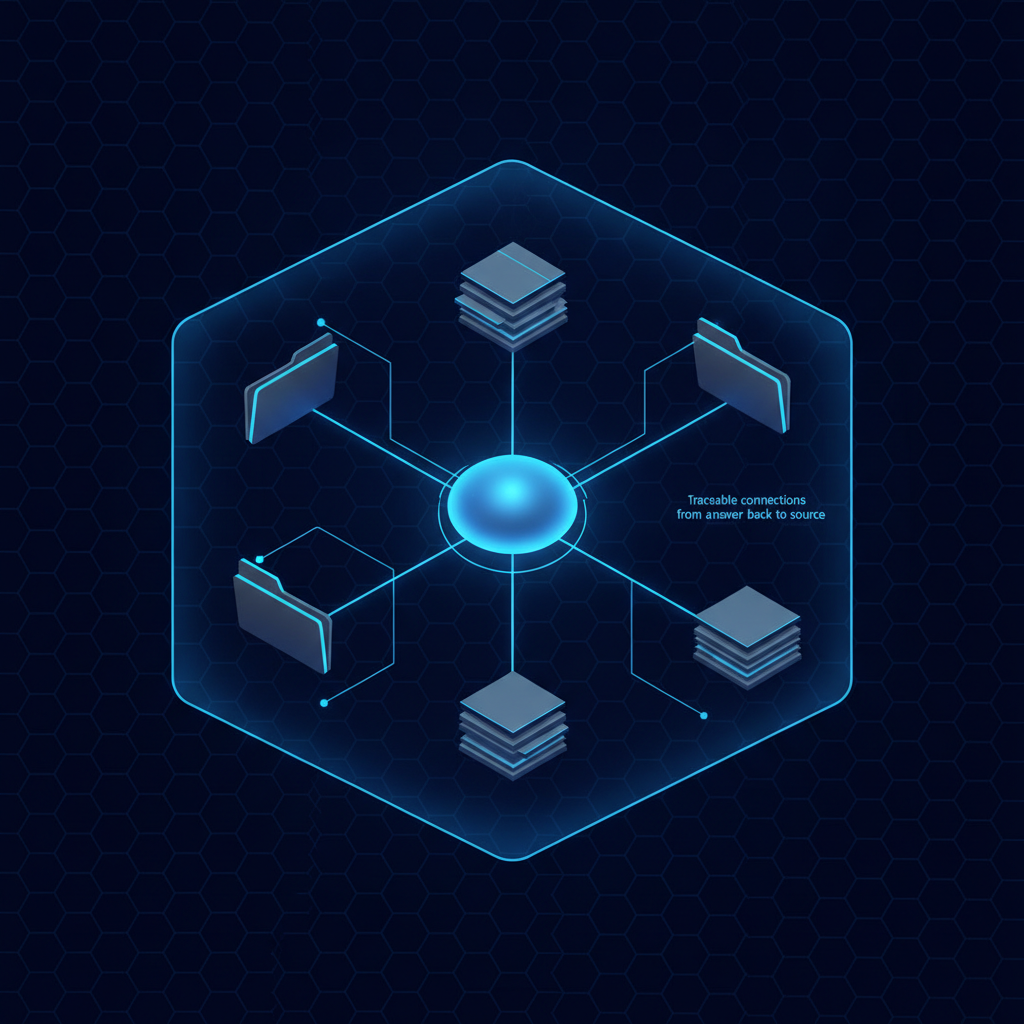
A Digital Worker does not „know" your company. It works on your data: documentation, ticket history, the files you point it at. The answer it puts together is built from those sources, not from what the model memorized during training. For a regulated manufacturer that is the whole difference: the data stays on your infrastructure, every answer can be traced back to a specific source, and access permissions are respected. This is the third post in the series on Digital Workers. The first explained the pricing model, the second the split of work inside a team, and this one goes deeper: how work on internal data actually looks, and what makes it trustworthy. Where its limits sit is the subject of the next and final post in the series.
The model does not „know", it reaches for sources
A large language model on its own carries general, and often stale, knowledge. The value lives in your documents, which no public model has ever seen. A Digital Worker does not guess from memory: for a given question it locates the relevant fragments in your sources and composes the answer from them. The industry name for this pattern is grounding an answer in sources (the RAG family of approaches). In practice it looks like this: asked about a specific procedure, a Digital Worker returns the passage from the right document rather than a plausible sounding sentence assembled from nothing. That difference is what decides whether the answers are usable in an environment where a mistake is expensive. There is a practical consequence on the other side too: if something is not in your material, a well built Digital Worker does not „fill in the gap", it flags that the sources do not contain the answer. We broke down the difference between this approach and a general copilot in the piece on a Digital Worker versus a copilot.
The data stays with you
Working on internal data only makes sense if that data never leaves your perimeter. In a dedicated (single-tenant) model, or on-prem, the sources and the processing itself stay on your infrastructure, they do not travel to a public model. For a team that has to demonstrate control over its data under NIS2, this is not cosmetics, it is the entry condition. Which deployment model fits which data we unpack in the piece on single-tenant versus shared cloud, and the wider regulatory context in NIS2 and AI: what applies.
Every answer traces back to a source
Grounding in sources has a side effect that, for a regulated manufacturer, matters more than convenience: every answer can be traced back to the document and passage it came from. That means the person approving the result does not have to take the machine's word for it, they can check where the answer came from. The same trail is what an auditor asks about: not „was the AI right", but „on what basis did the answer come about, and who accepted it". The split of accountability between the unit and the person we covered in the previous post on the team.
Permissions: the worker sees only what it should
Working on company data does not mean dumping everything into one bucket that everyone can reach. A sensibly built Digital Worker respects existing permissions: it answers from the sources the person asking already has access to, not from the entire body of company material. That matters with sensitive technical documentation, where „who can see what" is part of security, not an afterthought.
Answer quality follows source quality
Here we will be honest, because this is the most common letdown: a Digital Worker is only as good as the data it works on. If the documentation is inconsistent, duplicated, or out of date, the answers inherit those flaws. More often than not the problem is not a shortage of documents but a surplus: several versions of the same instruction, undated attachments, retired procedures no one formally removed. A Digital Worker will not settle for you which version is in force if that is not visible in the sources. That is why, in our practice, the first stage of a deployment is usually not „the model" but tidying up the sources: what is current, what is retired, which version is in force. It is less impressive than a demo, but it is exactly what decides whether working on your data produces a result you can trust.
What this does not mean
A few points, so there is no misunderstanding. Working on your data does not mean the model „learns" from it in the background and carries it off somewhere else. It does not mean full autonomy either: the answer is still a draft that a person accepts. And it does not mean a Digital Worker will answer everything that has a source. Where exactly the limits of what it will not do sit is the subject of the next and final post in the series.
Where to start
The safest first step is always the same: one narrow task with a clear, tidy source and a clear owner on your side. That single case shows whether working on your data delivers value before you widen the scope. If you want to work through this on your own specific documentation, book a call with Fryderyk. We will start with which source in your company is the right first test.
Author: Fryderyk Pryjma, CortexMine. We work with manufacturers on private Digital Worker deployments on their own infrastructure.
Prefer to check on your own first? The readiness mini-audit takes 10 minutes and leaves no data behind.